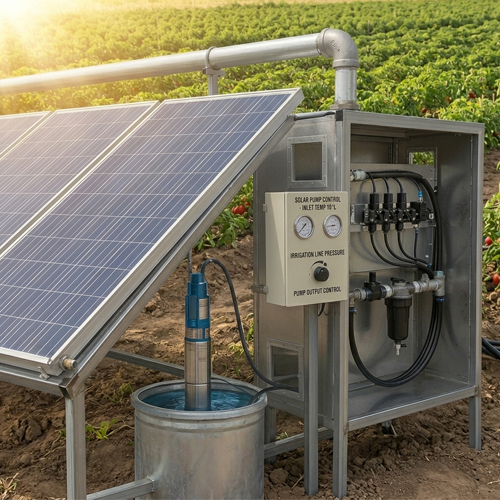
Solar Powered Submersible Pump (Drip-Irrigation)
Dhanashree Solar Energy Solutions is empaneled equipment Manufacturer/ Supplier in Fisheries & Aquaculture sector, recognized by National Fisheries Development Board in India. Dhanashree Solar Energy Solutions is on a mission to use environmentally friendly solar energy for cooking and preserving food. Dhanashree Solar Energy Solution offers a range of Solar products which includes Solar RO Water Purifier, Solar Freezers, Solar Heat Pump Dryers, Solar Powered Marine Pump and other customized solutions.
For Agriculture we offer Solar Powered Submersible Pump ( Drip-Irrigation), Solar Heat Dryer - Onion, Garlic, Vegetables, Full Processing, Solar Food Lights & Domestic Lights, Solar Powered Cold Storage (0.5T to 20T) Portable Freezer (50L-500L), Solar EV Rickshaw and minivan, Solar refrigerated Van for Agro Transport to Mandi / Markets, Solar Hybrid DC powered Atta Chakki / Mill, Solar Inverter for Agri Machinery, Farm Waste recycling machinery ( preventing stubble burning), Soil Testers, Fertilizer Dispensers, Pesticide Dispensing units.
Solar Powered Submersible Pump for Drip-Irrigation
A Solar-powered Submersible Pump for drip irrigation is a sustainable and efficient solution for agricultural irrigation needs, especially in remote or off-grid areas. Here are the key aspects to consider when implementing such a system:
Solar Panels capture sunlight and convert it into electricity to power the pump. The size and number of solar panels depend on the energy requirements of the pump and the amount of sunlight available in the location. The Submersible Pump is placed underwater, typically in a well or a water reservoir, and is responsible for pumping water to the surface and into the irrigation system. This manages the power supply from the solar panels to the pump. It ensures that the pump operates efficiently and protects it from voltage fluctuations.
Water Storage Tank can store water pumped during peak sunlight hours to be used when sunlight is not available. Drip Irrigation System includes a network of tubes, emitters, and valves that deliver water directly to the roots of the plants, minimizing water wastage.
Points to be considered while designing the Solar-powered Submersible Pump for drip irrigation
1.Water Requirements: Calculate the daily water needs of the crops to determine the capacity of the pump and the size of the solar array.
2.Head and Flow Rate: Determine the total head (the height the pump needs to lift the water) and the required flow rate to select an appropriate pump.
3.Solar Insolation: Evaluate the average solar radiation in the area to estimate the energy production potential of the solar panels.
4.Battery Storage (Optional): To ensure continuous operation during cloudy days or at night, a battery system can store excess solar energy.
Advantages of Solar-powered Submersible Pump for drip irrigation
- Sustainability: Utilizes renewable solar energy, reducing dependence on fossil fuels.
- Cost-Effective: After the initial investment, operational costs are minimal.
- Reliability: Ideal for remote areas with limited access to electricity.
- Water Efficiency: Drip irrigation reduces water wastage compared to traditional irrigation methods.
Installation Steps:
- 1.Site Assessment: Analyze the site for solar panel placement, ensuring maximum sunlight exposure.
- 2.System Sizing: Calculate the required capacity of the solar panels and pump based on water needs and sunlight availability.
- 3.Component Selection: Choose the appropriate solar panels, pump, controller, and drip irrigation components.
- 4.Installation: Set up the solar panels, install the submersible pump in the water source, connect the controller, and lay out the drip irrigation system.
- 5.Testing and Maintenance: Test the system to ensure it operates correctly and perform regular maintenance to ensure longevity.
Maintenance Tips for Solar-powered Submersible Pump for drip irrigation
- Regular Cleaning: Keep solar panels clean to ensure maximum efficiency.
- Inspect Connections: Regularly check electrical connections and plumbing for leaks or damage.
- Monitor Performance: Keep track of the system's performance and water output to identify any issues early.
Application industries for Solar-powered Submersible Pump for drip irrigation
- 1.Small to Medium-Sized Farms: Providing a consistent water supply for crops such as vegetables, fruits, and grains.
- 2.Orchards and Vineyards: Ensuring precise watering to optimize fruit yield and quality.
- 3.Remote Agricultural Operations: Facilitating irrigation in areas without access to reliable electricity.
- Community Gardens and Urban Farming: Supporting sustainable urban agriculture practices.